

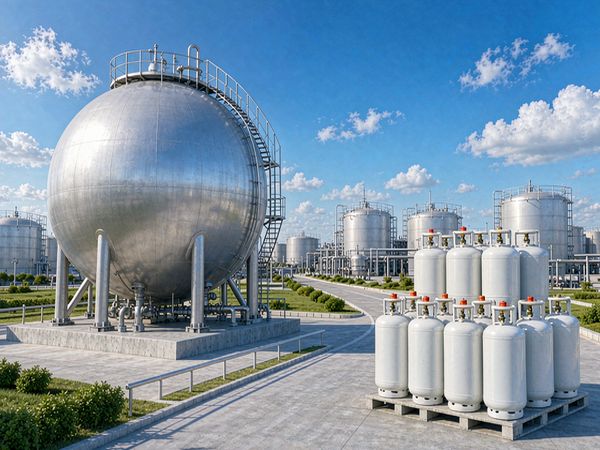
The choice between bulk LPG and LPG cylinders comes down to consumption, space and supply reliability — whether you install an LPG storage tank or keep working with a gas cylinder supplier and a simple propane tank.
There is no universally correct choice. A small restaurant and a large laundromat have different answers, and the right model can change as a business grows. Understanding the trade-offs makes the decision much easier.
The Cylinder Model
Cylinders are the default for small and medium operations. They require almost no infrastructure: a safe storage area, a regulator, and a relationship with a local refill supplier.
Advantages:
- Very low upfront investment.
- Easy to change suppliers.
- No permanent installation or land requirement.
- Scalable by simply adding cylinders.
- Suitable for remote locations without tanker access.
Limitations:
- Higher cost per unit of gas in most markets.
- Frequent delivery and handling.
- More manual work: moving cylinders, connecting regulators, monitoring stock.
- More cylinders to inspect, maintain and track.
- Greater exposure to running out at an inconvenient moment.
Cylinders make sense where consumption is modest, space is limited, or demand is variable. They are also the only practical option in many rural and urban locations where a tanker cannot deliver.
The Bulk Tank Model
A bulk system stores LPG in a fixed tank on site, refilled by tanker. The gas is supplied through a pipework system to the points of use.
Advantages:
- Lower gas cost per unit at sufficient volume.
- Fewer deliveries and less handling.
- Continuous supply with less risk of running out.
- Cleaner, more organized site.
- Better suited to high and steady demand.
Limitations:
- Significant upfront investment in tank, installation and pipework.
- Requires space, siting approval and safety distances.
- Ongoing obligations: inspection, certification, record-keeping.
- Less flexibility to switch suppliers.
- Requires tanker access and suitable delivery conditions.
Bulk works best where consumption is high and predictable, and where the business can justify the capital cost through gas savings and operational efficiency.
Finding the Break-Even Point
The decision usually comes down to consumption. While figures vary by market, a useful rule of thumb is that bulk becomes economical when a site uses more than roughly ten to fifteen cylinders a month. Below that, cylinder supply is usually cheaper overall. Above it, a tank often pays back within a few years.
A proper calculation should include:
- Delivered gas price under both models.
- Capital and installation cost of the tank.
- Delivery frequency and cost.
- Labour involved in handling cylinders.
- Storage space requirements.
- Inspection and compliance costs.
- Expected business growth over five years.
Many businesses discover that labour is the hidden factor. Moving, connecting and monitoring dozens of cylinders consumes staff time that is easy to overlook in a simple gas-price comparison.
Safety and Compliance Differences
Both models are safe when properly managed, but the obligations differ.
Cylinder systems require correct storage, segregation, valve protection, secure upright positioning, leak checks and a managed inspection schedule. The business must make sure cylinders are certified and correctly filled.
Bulk systems add fixed-installation requirements: siting distances, foundations, pipework design, pressure regulation, emergency shut-off, tank inspection and record-keeping. These are usually more demanding but also more structured.
Qingdao Evergreen Import and Export Co., Ltd. supplies cylinders to businesses at both ends of this spectrum. A common pattern we see is a company that starts with cylinders, grows, and eventually adds a bulk tank while keeping cylinders as backup — a sensible hybrid for many operations.
The Hybrid Option
Many businesses do not choose one model exclusively. They install a bulk tank for base load and keep cylinders for:
- Backup during tanker delays.
- Seasonal demand peaks.
- Remote or satellite sites.
- Temporary operations.
This approach costs more than a pure bulk system but reduces the risk of interruption, which can be extremely expensive for a restaurant, hotel or production line.
Questions to Ask Before Deciding
- What is your average and peak monthly gas consumption?
- Do you have space that meets tank siting requirements?
- Can a tanker reach your site year-round?
- How much staff time goes into handling cylinders today?
- How reliable is your current refill supplier?
- What are your growth plans over the next three to five years?
- What compliance obligations are you prepared to manage?
Honest answers to these questions usually make the decision clear.
Quick Takeaways
- Cylinders suit low or variable demand with minimal infrastructure.
- Bulk tanks suit high, steady demand and reduce long-term gas cost.
- Labour and handling time often decide the economics as much as gas price.
- Bulk systems carry more fixed compliance obligations.
- A hybrid setup provides backup and flexibility for growing businesses.
Frequently Asked Questions
When does bulk LPG become cheaper than cylinders?
Often when consumption exceeds roughly ten to fifteen cylinders a month, though local prices and installation costs change the figure.
Can I switch from cylinders to bulk later?
Yes. Many businesses do so as they grow, often keeping cylinders as backup.
How much space does a bulk tank need?
It depends on tank size and local safety distances, which are set by regulation. Check with the local authority before planning.
Are cylinders safer than bulk tanks?
Both are safe when correctly installed and managed. The main difference is the type of compliance obligation.
| About Qingdao Evergreen Import and Export Co., Ltd. Qingdao Evergreen Import and Export Co., Ltd. manufactures and exports LPG cylinders, valves and gas fittings to markets worldwide, supporting buyers with region-specific specifications, certification and reliable supply. |
The bottom line: match the supply model to real consumption — and leave room for growth.


