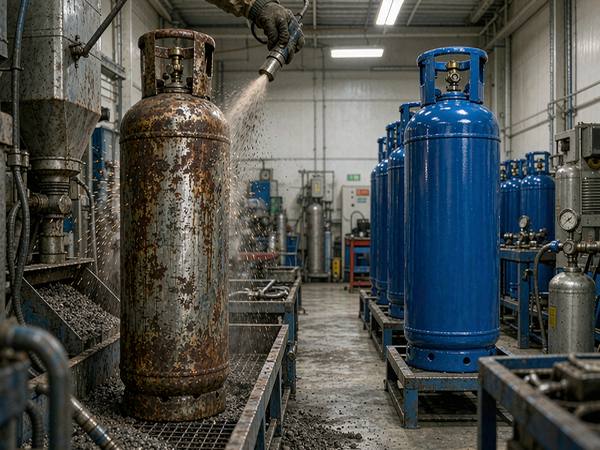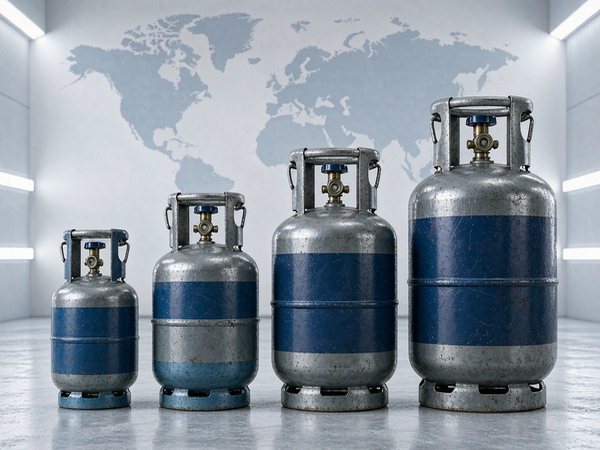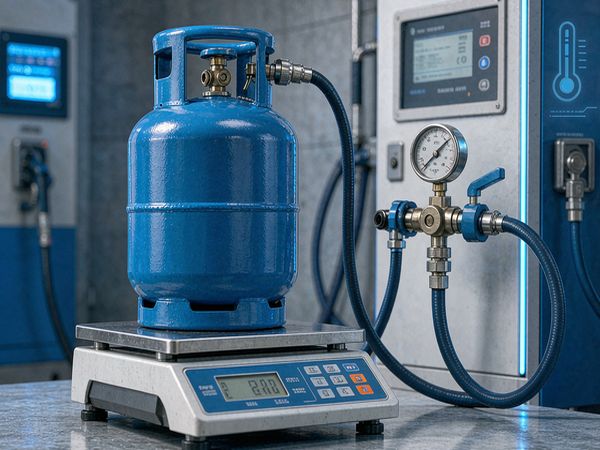
Safe LPG cylinder filling depends on three things: knowing the cylinder capacity, avoiding cylinder overfilling, and fitting an OPD valve where the market requires one — whether you fill a small propane tank or a larger one.
LPG cylinders are filled to roughly 80 percent of their water capacity. The empty space is not wasted capacity. It is a deliberate safety margin that keeps the cylinder safe when the temperature rises. Understanding why this matters is essential for anyone who fills, transports, stores or buys gas cylinders.
What the 80 Percent Rule Actually Means
Every cylinder has a water capacity — the total volume of water it could hold if completely full. For a typical 20lb propane cylinder, that is about 27 pounds of water. The approved maximum fill is about 80 percent of that, which works out near 20lb of LPG.
The remaining 20 percent is vapour space. It exists because LPG is stored as a liquid under pressure, and liquids expand when heated. If a cylinder were filled to the brim on a cool morning, a hot afternoon could push the liquid expansion to the point where there is no room left for vapour. Pressure would then rise extremely fast, potentially lifting the relief valve or, in a worst case, rupturing the vessel.
This is not theoretical. Overfilled cylinders are a recognized cause of incidents in hot climates, in enclosed vehicles and near heat sources. The rule exists precisely to prevent that scenario.
The Physics in Plain Language
LPG has a high coefficient of thermal expansion — roughly sixteen times that of water. A small temperature increase produces a noticeable volume increase. At the same time, the vapour pressure inside the cylinder rises with temperature.
When there is adequate vapour space, the liquid can expand into that space and the pressure follows a predictable saturation curve. When there is no space, pressure climbs far more steeply. The relief device is designed to open under abnormal pressure, but a relief valve venting flammable gas is still a serious event. The 80 percent fill keeps the system comfortably inside its design envelope.
Temperature is why the rule is stricter in some places. Many regulations reduce the maximum filling percentage in very hot climates or require additional checks during summer months. A fill that is acceptable at 10°C may be unsafe at 40°C.
How Filling Stations Apply It
Modern filling plants do not rely on guesswork. Several methods are used:
- By weight: the cylinder is weighed before and after filling, which is the most common method.
- By volumetric or gravimetric filling machines: automated systems stop at a preset weight.
- By fixed liquid level gauge: an OPD (overfill prevention device) valve stops flow when liquid reaches the correct level. Many North American cylinders now require OPD valves.
Operators are trained to check the cylinder’s tare weight, which is stamped on the collar or stamped permanently on the bottle. Using the wrong tare weight is a classic cause of overfilling.
Qingdao Evergreen Import and Export Co., Ltd. works with filling operators across multiple markets, and we consistently see the same pattern: the best-run plants treat fill control as a measured process with records, not a habit. They calibrate scales regularly and train operators to recognize temperature-related adjustments.
What Buyers and Users Should Check
If you purchase cylinders or manage a fleet, there are practical things to watch:
- Check that cylinders have a legible tare weight marking.
- Confirm that the filling plant uses calibrated scales.
- Look for OPD valves where required.
- Never refuel a cylinder that has been exposed to fire or severe heat.
- Store cylinders upright and away from direct sunlight where possible.
- Never transfer LPG between cylinders yourself.
An overfilled cylinder may look completely normal. The only reliable protection is disciplined filling practice and the correct valve equipment.
Transport and Storage Implications
The rule also explains transport regulations. Vehicles carrying LPG cylinders must allow ventilation and protect bottles from heat. Cylinders in closed vans or containers parked in the sun are a known risk, which is why many markets restrict how cylinders may be shipped and stored.
For exporters, this matters during container loading. Cylinders shipped empty still need care, but cylinders shipped with residual product require dangerous goods documentation and compliance with ADR, IMDG or local equivalents.
Why It Matters Commercially
Overfilling is sometimes driven by a commercial motive: giving the customer “more gas” seems like good service. In reality, it transfers risk to the customer and exposes the filling business to liability. Underfilling, on the other hand, damages trust. Precise, repeatable filling protects both sides.
Better cylinder design helps too. Accurate tare weight marking, reliable valves and clear capacity labelling all reduce the chance of human error at the filling point.
Quick Takeaways
- Cylinders are filled to about 80 percent of water capacity to leave expansion space.
- LPG expands far more than water when heated, making the empty space essential.
- Overfilling is a serious safety hazard, especially in hot conditions.
- Accurate tare weight marking and calibrated scales are the main controls.
- OPD valves provide an additional layer of protection in many markets.
Frequently Asked Questions
Why not fill a cylinder all the way?
Because liquid LPG expands with heat. Without vapour space, pressure can rise dangerously fast.
Is 80 percent the same everywhere?
Broadly yes, but some regulations reduce the percentage in hot climates or require seasonal adjustment.
What is an OPD valve?
An overfill prevention device that stops filling when the liquid reaches the correct level, common on smaller propane cylinders.
Can I tell if a cylinder is overfilled?
Not reliably by sight. Weight and proper filling equipment are the only real safeguards.
| About Qingdao Evergreen Import and Export Co., Ltd. Qingdao Evergreen Import and Export Co., Ltd. manufactures and exports LPG cylinders, valves and gas fittings to markets worldwide, supporting buyers with region-specific specifications, certification and reliable supply. |
The bottom line: the empty space in a gas cylinder is not wasted capacity — it is the safety margin that keeps the whole system working.