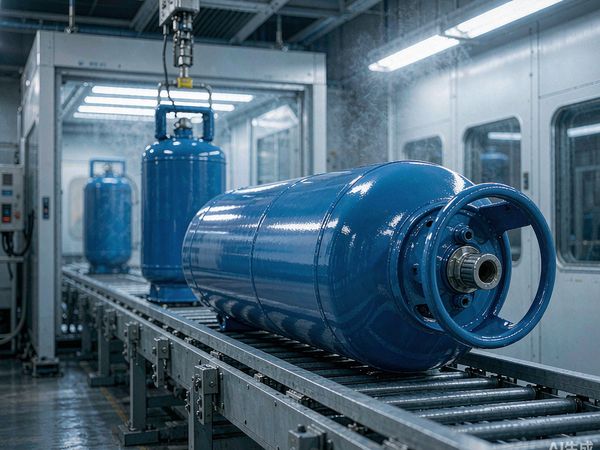

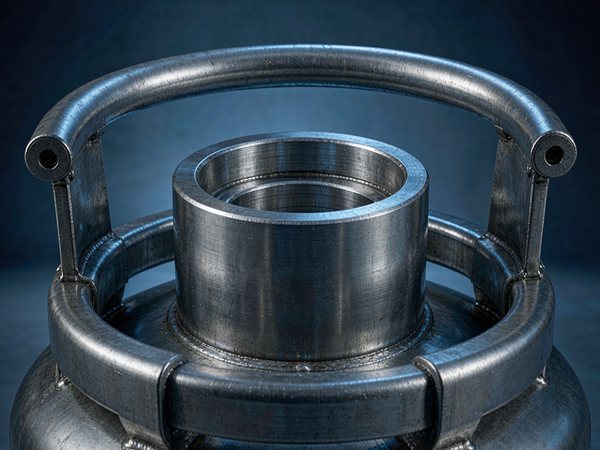
Three LPG cylinder parts do most of the work in daily handling: the cylinder collar provides valve protection, the cylinder foot ring keeps the bottle stable, and the cylinder handle determines how safely it can be lifted.
A cylinder is not just a pressure vessel. It is a piece of handling equipment. The hardware around the shell is what makes it usable and safe in a busy depot or a household.
The Collar: More Than a Protective Ring
The collar is the ring at the top of the cylinder surrounding the valve. Its primary job is protection: if the cylinder falls over, the collar takes the impact instead of the valve. A damaged valve can release gas; a dented collar is a cosmetic problem.
But the collar does more. It provides a lifting point, carries identifying markings, and often carries the tare weight and test date that filling operators depend on. A collar that is too thin, poorly welded or damaged can compromise both protection and traceability.
Quality collars are:
-
- Thick enough to absorb a fall without bending into the valve.
- Securely welded to the shoulder.
- Clear of the valve enough to allow connection and operation.
- Marked legibly and permanently.
Buyers should check the weld between collar and shell. It is a high-stress area and a common site of fatigue cracking in cylinders that are handled roughly.
The Foot Ring: The Unsung Hero of Stability
The base, or foot ring, is the ring that lets a cylinder stand upright. It sounds trivial until you watch a cylinder on uneven ground in a windy depot. A poorly designed base lets the cylinder wobble, which puts stress on the valve connection and makes leaks more likely.
A good foot ring distributes weight evenly, resists deformation when the cylinder is set down hard, and provides enough diameter to keep the bottle stable. It also protects the bottom of the shell from direct contact with wet or abrasive surfaces, which is where corrosion often starts.
In high-turnover operations, foot rings take enormous punishment. Cylinders are dragged, rolled, loaded and unloaded many times a week. A base that deforms after a few months turns a cylinder into a safety problem, because a bent base can hide cracks in the shell above it.
The Handle: Designed for Human Hands
Handles vary widely by market and cylinder size. Some are cut into the collar; others are separate welded grips. The design seems minor, but it determines whether workers move a cylinder safely or awkwardly.
A good handle:
-
- Allows a balanced two-handed grip.
- Clears the valve so the hand is not near the connection point.
- Has no sharp edges that can cut gloves or skin.
- Is positioned where the cylinder’s weight feels manageable.
Poor handle design encourages bad lifting technique. Workers grip the valve or the neck instead of the handle, which is exactly what safety training tells them not to do. Over time, a badly designed handle quietly increases the risk of valve damage and strain injuries.
How These Parts Affect Certification
Hardware is not just a convenience. Certification standards often specify requirements for collars, bases and valves because they are part of the safety system. A cylinder may have an excellent shell and still fail approval if the collar or base does not meet the standard.
Marking requirements are another connection. Standards typically require permanent markings in a specified location, often on the collar. If the collar is too small, too thin or poorly finished, the marking may not be legible or durable, which can cause rejection at inspection.
Qingdao Evergreen Import and Export Co., Ltd. pays particular attention to these components because they are where daily use meets regulatory requirement. A cylinder that passes the test but is difficult to handle safely is not a good cylinder.
What to Check on a Sample
You can assess hardware without special equipment:
-
- Set the cylinder on an uneven surface and check for wobble.
- Lift it by the handle and check the balance.
- Examine the collar welds for uniformity and spatter.
- Check that markings are clear and correctly positioned.
- Verify that the valve can be connected and operated without the collar interfering.
- Look for sharp edges on the handle and collar.
- Check that the foot ring sits flat and shows no signs of bending.
These simple checks reveal a lot about how much care went into the cylinder.
Design Differences by Market
Different regions favour different hardware. North American barbecue cylinders often have a wide, integrated collar handle. European exchange cylinders may use a different handle and a more robust base for repeated depot handling. Asian household cylinders frequently use a compact collar with a cut-out grip.
These differences are not arbitrary. They reflect how the cylinder is actually moved in each market. When sourcing for a new region, ask whether the hardware matches local handling practice, not just whether the shell meets the pressure standard.
Quick Takeaways
-
- The collar protects the valve and carries critical markings.
- The foot ring provides stability and protects the shell bottom.
- Handle design directly affects safe lifting technique.
- Hardware is part of certification, not an optional extra.
- Simple physical checks on a sample reveal most hardware quality issues.
Frequently Asked Questions
Why is the collar so important?
It shields the valve from impact during a fall and usually carries the permanent markings needed for identification.
Can a damaged foot ring be repaired?
Minor damage may be repairable by an approved facility, but significant deformation usually means the cylinder should be condemned.
Do handles affect certification?
Indirectly, yes. Standards cover handling features, and marking placement is often tied to the collar design.
Are hardware designs the same everywhere?
No. They differ by region according to local handling and refill practices.
|
About Qingdao Evergreen Import and Export Co., Ltd. |
The bottom line: the parts that look smallest are often the ones that keep a cylinder safe in daily use.