
A cylinder does not fail because it looks bad. It fails because something invisible started on the surface and worked its way inward. Rust is patient. It begins at a scratch, a weld seam or a chipped edge, and given moisture and time it turns a pressure vessel into a liability. That is why surface treatment is not a cosmetic step at the end of production — it is one of the most important determinants of how long a cylinder stays in service.
For buyers comparing cylinders, coating is often the least examined line on a quote. Two bottles can look identical on the shelf and behave completely differently after three years in a humid coastal depot. Here is what actually separates a coating that protects from one that merely covers.
Why the Surface Matters More Than You Think
Steel is strong but chemically impatient. Exposed to oxygen and water, it begins to corrode almost immediately. A cylinder‘s coating is the barrier that keeps the environment away from the metal. When that barrier is thin, poorly cured or applied to an imperfect surface, corrosion starts underneath the paint where nobody can see it.
This matters commercially because a corroded cylinder usually cannot be refurbished economically. It must be scrapped. Every year of extra service life spreads the original manufacturing cost across more fill cycles, which lowers the true cost per delivery. A slightly more expensive cylinder with a superior coating is frequently the cheaper asset over a decade.
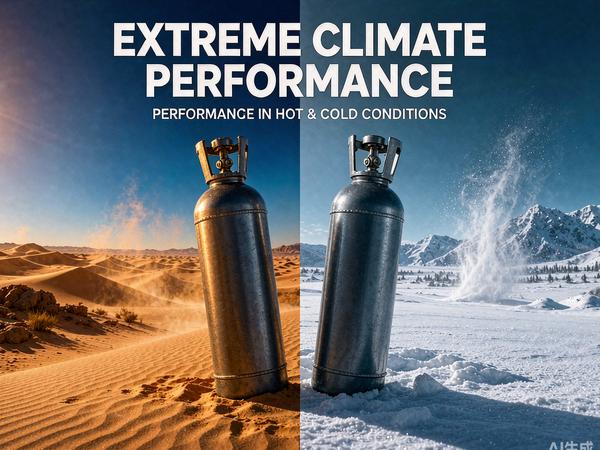
The coastal problem is worth calling out. In high-salinity air, chloride ions accelerate corrosion dramatically. A cylinder that lasts fifteen years inland may struggle to reach eight near the coast with the same coating. If your distribution area includes ports, islands or humid tropics, coating specification is not optional — it is the deciding factor.
Powder Coating vs Wet Paint: The Real Difference
Powder coating and traditional liquid paint are the two dominant methods, and the difference is more than application technique.
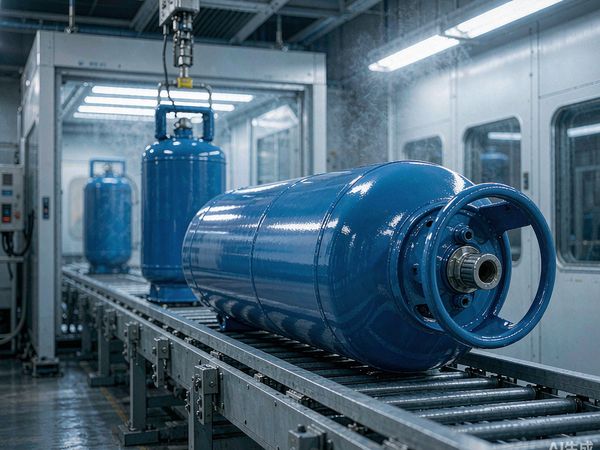
Powder coating uses a dry powder, typically polyester or epoxy-polyester, that is electrostatically charged and sprayed onto the cylinder. The coated part is then heated so the powder melts, flows and cures into a continuous film. The result is a harder, more uniform layer with no solvent to evaporate.
Wet paint relies on liquid solvents or water that must dry or cure. It is flexible and easy to touch up, but it generally produces a thinner film and is more dependent on application skill and environmental conditions such as humidity and temperature during curing.
Key practical differences:
- Film thickness: Powder typically delivers a thicker, more consistent layer in a single pass.
- Edge coverage: Electrostatic powder wraps reasonably well around edges and welds, which are the most corrosion-prone zones.
- Curing control: Powder requires precise oven temperature and time. Under-cured powder looks fine but performs poorly.
- Repairability: Wet paint is easier to touch up in the field. Powder damage often requires re-coating in a controlled process.
- Environmental impact: Powder produces almost no volatile organic compounds, which increasingly matters for compliance.
Neither method is universally better. Powder excels in factory consistency and durability; wet paint wins in flexibility and field repair. High-volume cylinder production has steadily moved toward powder for exactly the consistency reason.
The Preparation Step That Decides Everything
Any coating specialist will tell you that preparation determines perhaps eighty percent of coating performance. A perfect powder applied over oil, rust or mill scale will fail prematurely.
A proper preparation line includes degreasing to remove oils from forming and handling, shot blasting or abrasive cleaning to remove rust and create a surface profile, and thorough dust removal before coating. The surface profile gives the coating something to grip mechanically, not just chemically.
Buyers should ask suppliers what their preparation process is, not just what coating they use. A supplier who can describe blast media, surface profile and cleaning steps is managing the process. One who only names a paint brand is not.
The weld seam deserves special attention. Welding changes the surface chemistry and can leave spatter or discolouration that interferes with adhesion. Cylinders whose welds are cleaned and inspected before coating will outperform those where coating simply covers the weld.
What to Look for on a Finished Cylinder
You do not need laboratory equipment to spot obvious coating problems.
Look at the edges and the base ring. These are high-wear areas where coating is most likely to be thin. Check for orange-peel texture, runs, pinholes or areas of different gloss. Inspect the area around the valve boss, where handling damage is common.
Ask for the specified dry film thickness and the test method. A supplier who can state a number and show how it is measured is operating with control. Also ask about adhesion testing and cure verification. These are routine checks in a serious coating line.
Color itself matters less than people assume, but consistency has a practical benefit: a recognizable, uniform finish makes it easier to spot damage and unauthorized repainting during inspection.
The Compliance and Sustainability Angle
Coating regulation is tightening. Restrictions on volatile organic compounds and hazardous pigments have pushed the industry toward powder and water-based systems. For exporters, this means a coating that was acceptable in one market may need re-approval in another.
There is also a carbon story. A longer-lasting cylinder reduces replacement frequency and the embodied carbon of manufacturing. Powder coating’s low waste and long life fit well with sustainability claims that buyers increasingly need to substantiate. Be cautious of vague “eco-friendly” language; ask for service-life data and coating specifications instead.
Where Coating Choices Pay Back Fastest
If you operate in a corrosive environment, the return on a better coating shows up quickly:
- Coastal and island distribution, where salt accelerates corrosion.
- Humid tropical markets with year-round moisture.
- Industrial areas with airborne chemicals.
- High-turnover fleets where cylinders are constantly handled and scratched.
- Long-haul export where cylinders sit in containers for weeks.
In these conditions, the difference between an adequate coating and a good one can be measured in years of additional service.
Practical Advice for Buyers
Start by defining your operating environment honestly. If your cylinders live outdoors in a humid port city, specify accordingly rather than buying a generic standard.
Ask suppliers for coating specifications, preparation procedures and quality-control records. Request samples from a recent production batch rather than a showroom piece. If possible, run a simple salt-spray comparison using samples from two suppliers — the difference is often striking.
Finally, treat coating as part of a lifecycle system. Even the best finish needs inspection. Train staff to report chips and scratches early, and establish a re-coating standard for cylinders that remain structurally sound.
Quick Takeaways
- Corrosion, not appearance, is the real enemy of cylinder service life.
- Powder coating gives a thicker, more consistent film; wet paint is easier to repair.
- Surface preparation determines most of a coating’s performance.
- Weld seams and base rings are the highest-risk zones.
- Better coating pays back fastest in coastal, humid or high-handling operations.
Frequently Asked Questions
How long does a powder-coated cylinder last compared with a painted one?
It depends on environment and prep quality, but powder-coated cylinders often deliver several additional years of service in corrosive conditions.
Can a damaged coating be repaired in the field?
Small areas can be touched up, but large damage should be handled through a controlled refurbishment process with proper testing.
Does coating affect certification?
The coating itself usually does not change the pressure approval, but the specification may need to meet local environmental or marking rules.
What is the most common coating failure?
Poor surface preparation, which causes the coating to peel or blister from underneath.
The bottom line: a cylinder’s coating is not the last step in manufacturing. It is the first line of defence in a long service life — and the one buyers most often under-specify.