Why this matters
- Most cylinder incidents come from process failures, not manufacturing defects.
- Audit identity, test dates, valves, visual condition and storage every cycle.
- The valve is the highest-risk component and deserves its own controls.
A leaking cylinder does not just fail a test. It ends up in a customer’s kitchen, a restaurant’s back alley, or a campsite at midnight — and the story that follows is never about the manufacturer. It is about the name on the delivery van. That is why cylinder safety has quietly stopped being a technical back-office topic and become a brand-protection issue for every distributor, retailer and refill operator.
Regulators have noticed too. Across major markets, enforcement is shifting from paperwork checks to lifecycle accountability: who filled it, when it was last tested, whether the valve matches the cylinder, and whether the bottle still has a traceable identity. If your audit process stops at “it looks fine,” you are already behind.
Why Safety Failures Are Rarely Random
When a cylinder incident happens, investigators almost never find a single dramatic cause. They find a chain of small compromises.
A batch of valves purchased from an unvetted supplier. A hydrostatic test date that was never updated in the system. A cylinder that was repainted without removing corrosion underneath. A driver who swapped a damaged valve for whatever fit in the truck. None of these decisions feels catastrophic in isolation. Together, they create exactly the kind of failure that makes headlines.
The uncomfortable truth is that most cylinder incidents are process failures, not product failures. A well-made cylinder that has been mishandled is more dangerous than a mediocre one that has been inspected properly. That is why the strongest safety programmes focus less on the steel and more on the system around it.
The Five-Point Audit Every Distributor Should Run
If you want a practical starting point, audit these five areas before your next refill cycle.
- Identity and traceability
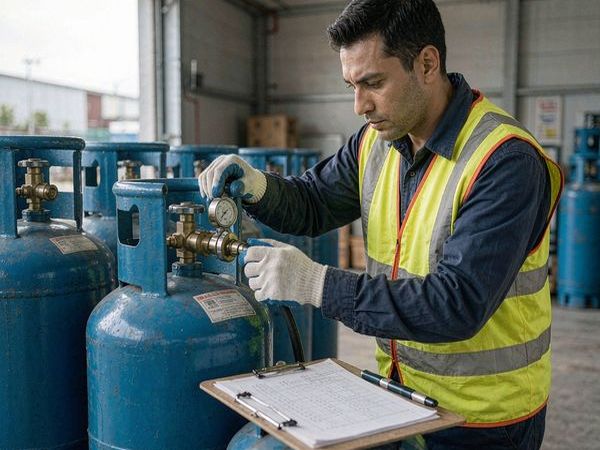
Every cylinder in your custody should have a readable, permanent identification mark and a matching record. If a bottle cannot be matched to a batch, a manufacture date and a test history, it should be quarantined. In an era of digital records, “we think it came from that shipment” is not an acceptable answer.
- Test dates and retest intervals
Hydrostatic testing is not a formality — it is the single best check on a cylinder’s structural integrity. Retest intervals vary by market and cylinder type, so the rule must be explicit in your operating manual. Build a simple dashboard that flags cylinders approaching their retest window instead of relying on someone to remember.
- Valve compatibility and condition
The valve is the most handled, most abused and most frequently replaced component on a cylinder. Wrong thread, wrong pressure rating, worn seal, damaged handwheel — any of these can turn a sound cylinder into a leak. Maintain an approved valve list and never allow field substitutions without a documented check.
- Visual condition and corrosion
Surface rust is not automatically a death sentence, but rust around the weld seam, base ring or valve boss deserves immediate attention. Train staff to look at the bottom of the cylinder, not just the label. Cylinders that sit on wet concrete in coastal or high-humidity environments need shorter inspection intervals than the standard schedule suggests.
- Storage and handling discipline
Many incidents happen in the yard, not on the road. Cylinders stored near heat sources, stacked insecurely, or dragged across rough ground accumulate damage that never shows up in a paperwork audit. A ten-minute walk-through with a checklist will catch problems that a quarterly report will not.
The Valve Problem Deserves Its Own Meeting
If there is one component worth obsessing over, it is the valve. It controls flow, it takes the daily punishment of connection and disconnection, and it is the part most likely to be swapped casually.
A mismatched valve can create a leak path even when the cylinder body is perfect. A valve with the wrong pressure-relief setting can defeat the safety system the whole design depends on. And a counterfeit valve — often visually identical to a certified one — can fail without warning.
Practical controls are simple but non-negotiable: buy valves only from approved sources, keep batch records, inspect threads and seals on receipt, and train delivery staff to report any valve that feels loose or seats incorrectly. If your team treats valves as commodities, your safety system has a hole in it.
Training Is the Cheapest Insurance You Can Buy
You can install the best tracking software in the world and still fail if the person lifting the cylinder does not know what to look for. Effective training is short, visual and repeated.
Show drivers real examples of damaged valves, expired test stamps and corroded bases. Give them a one-page “stop and report” rule with no ambiguity: if something looks wrong, the cylinder does not go out. Remove any incentive that rewards speed over reporting. A driver who reports three suspect cylinders a week is not slowing you down — they are protecting you.
Refill plants need the same discipline. Operators should be authorised to reject a cylinder without asking permission. If rejection requires a manager’s approval, rejection will quietly stop happening.
The Compliance Curve Is Getting Steeper
Across North America, Europe, Australia and parts of Asia, documentation requirements are tightening. Authorities increasingly expect digital traceability, clear test records and evidence of staff competence. The direction is consistent even if the timelines differ.
For exporters and distributors operating in several markets, this creates a practical challenge: one cylinder may need to satisfy different documentation standards depending on where it ends up. The solution is not to build separate systems for every country. It is to adopt the strictest common standard internally, then map it to local requirements at the point of sale.
That approach reduces complexity, makes audits easier, and gives you a defensible position if a regulator or customer asks hard questions.
What “Good” Looks Like in Practice
A mature cylinder safety programme has a few unmistakable features:
- Every cylinder has a unique identity and a live record.
- Retest dates are tracked automatically, not manually remembered.
- Valves come from approved, audited sources with batch traceability.
- Field staff are trained and empowered to reject cylinders.
- Storage areas are inspected on a fixed schedule with photos.
- Incidents and near-misses are logged and reviewed, not forgotten.
None of this is exotic. It is operational discipline applied consistently. The companies that get this right rarely make the news. The ones that get it wrong usually do.
The Commercial Case Is Stronger Than the Compliance Case
Safety programmes are often sold internally as a cost of doing business. That undersells them. Good cylinder management reduces product loss, lowers insurance exposure, improves customer trust and shortens dispute resolution. Distributors with clean traceability recover stolen cylinders faster, win tenders more easily, and handle warranty claims with facts instead of guesswork.
In a market where customers increasingly ask about origin and certification before they sign a supply agreement, safety documentation is a sales asset. Treat it that way.
Quick Takeaways
- Most cylinder incidents come from process failures, not manufacturing defects.
- Audit identity, test dates, valves, visual condition and storage every cycle.
- The valve is the highest-risk component and deserves its own controls.
- Empower field staff to reject cylinders without permission.
- Adopt the strictest common standard across all markets you serve.
Frequently Asked Questions
How often should cylinders be visually inspected?
At every fill at minimum, with more frequent checks in corrosive or high-humidity environments. Follow your local regulatory schedule as the baseline.
Can a cylinder be repainted after corrosion is found?
Only after the affected area is properly assessed and the cylinder passes the required test. Painting over active corrosion hides the problem rather than solving it.
What should happen to a cylinder with an unreadable stamp?
Quarantine it immediately. Without a traceable identity, its test history cannot be verified.
Who is responsible for safety — the manufacturer, filler or distributor?
All three, but the distributor usually owns the customer relationship and therefore the reputational risk. Clear contracts help, but they do not remove that exposure.
The bottom line: safety is no longer the department that stamps paperwork. It is the system that decides whether your brand survives its next bad day.