
A well-run cylinder exchange system keeps gas moving without customers ever owning a bottle: an LPG cylinder deposit makes the cylinder a reusable asset, a gas bottle exchange swaps empty for full at the counter, and a cylinder rental model or cylinder pooling arrangement gives distributors control over a circulating fleet that can be inspected, tracked and replaced.
In many markets, the exchange model is the backbone of household gas distribution. It lowers the barrier for customers, keeps quality under the distributor’s control and creates a repeating revenue relationship. For manufacturers, it changes what the customer actually values in a cylinder.
Why Exchange Models Dominate
Buying a cylinder outright is expensive for a household and creates a long-term asset the customer must maintain. Exchange removes both problems. The customer pays a deposit or a small rental fee, takes a filled cylinder, and swaps it when empty.
The distributor keeps ownership of the cylinder, which means:
- Quality stays under professional control.
- Cylinders are inspected and requalified on schedule.
- Lost or damaged cylinders can be tracked.
- Customers return repeatedly to the same supplier.
- A single fleet serves thousands of households over many years.
This is why exchange systems are common in Europe, parts of Asia and many organised LPG markets.
How the Deposit Works
Under a deposit system, the customer pays an upfront amount for the cylinder. That deposit is refundable when the cylinder is returned in acceptable condition. The gas itself is sold separately.
The deposit amount is usually set close enough to the cylinder’s value to discourage loss, but low enough to remain affordable. Setting it correctly is a balancing act: too high and adoption suffers, too low and cylinder losses rise.
Some markets use a nominal deposit with a strong tracking system instead. Others rely on the deposit as the main protection against loss.
Gas Bottle Exchange at the Counter
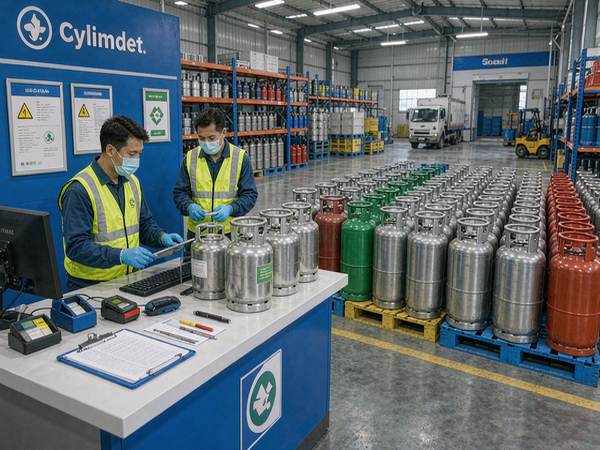
The customer experience is simple: bring an empty cylinder, receive a full one, pay for the gas. Behind that simplicity is a substantial operation.
A filling plant must maintain a stock of full cylinders, inspect every returned bottle, refill it safely and keep records. Peak demand creates pressure on inventory, which is why exchange networks need more cylinders than the number of active customers would suggest.
A practical rule in the industry is that a fleet needs a significant buffer — often twenty to thirty percent above active customer numbers — to cover cylinders in transit, at filling, under inspection and in reserve.
Cylinder Rental Models
A pure rental model charges a periodic fee rather than a deposit. This is common in commercial settings and in pay-as-you-go systems, where customers make small regular payments that include cylinder access and gas.
Rental models work well where:
- Customers have irregular consumption.
- Upfront payments are a barrier.
- Digital payment and metering are available.
- The distributor wants predictable recurring revenue.
They require more administrative systems than a simple deposit, but they can reach customers who could never afford an upfront cylinder purchase.
Cylinder Pooling and Fleet Management
Large exchange networks increasingly treat cylinders as a shared pool. Every bottle is an asset with an identity, a test date and a location in the system.
Effective cylinder pooling depends on:
- Unique serial numbers or digital tags.
- Accurate records of issue and return.
- Scheduled requalification before deadlines.
- Clear criteria for condemning cylinders.
- Enough spare capacity to absorb demand peaks.
Qingdao Evergreen Import and Export Co., Ltd. supplies cylinders designed for high-cycle exchange systems, with durable markings and robust hardware that survive repeated handling across many years of service.
What This Means for Cylinder Design
In an exchange system, the cylinder is handled far more often than in a household ownership model. That changes the specification priorities:
- Stronger collars and bases that survive repeated lifting and setting down.
- More durable coatings that resist constant scratches.
- Clear, permanent markings that remain readable for the full service life.
- Reliable valves that can be serviced many times.
- Standardised dimensions that fit existing depots and vehicles.
The cheapest cylinder is rarely the best choice for a high-turnover pool. Durability and traceability reduce the total cost per fill cycle.
Economics of the Model
For the distributor, the economics depend on fleet utilisation. A cylinder that circulates for fifteen years and is filled hundreds of times delivers a very low cost per delivery, provided it is not lost or condemned early.
Key cost drivers include:
- Initial cylinder purchase.
- Loss rate.
- Damage and condemnation rate.
- Refill and logistics cost.
- Inspection and requalification cost.
- Administrative overhead.
Reducing loss and extending service life have a greater impact than shaving a small amount off the purchase price.
Common Challenges
Exchange systems face recurring problems:
- Cylinder loss, especially in informal markets.
- Customers keeping cylinders beyond the return deadline.
- Damaged cylinders entering the pool without detection.
- Inconsistent record-keeping.
- Counterfeit cylinders entering the system.
Each of these requires a combination of tracking, inspection and customer policy. Technology helps, but disciplined operations matter more than software.
Quick Takeaways
- Exchange systems keep cylinder ownership with the distributor.
- Deposits must balance affordability against loss prevention.
- A fleet needs a buffer of roughly twenty to thirty percent above active customers.
- High-cycle pools need durable, well-marked cylinders.
- Tracking and inspection matter more than the initial purchase price.
Frequently Asked Questions
Why do customers prefer cylinder exchange?
It removes the large upfront purchase and the responsibility for maintenance and testing.
What happens to a damaged cylinder in an exchange system?
It is removed from the pool, inspected and either reconditioned or permanently scrapped.
How are cylinder losses controlled?
Through deposits, tracking systems, customer records and regular reconciliation.
Is rental better than deposit?
It depends on the market. Rental suits irregular users and digital payment systems; deposit suits simple household distribution.
| About Qingdao Evergreen Import and Export Co., Ltd. Qingdao Evergreen Import and Export Co., Ltd. manufactures and exports LPG cylinders, valves and gas fittings to markets worldwide, supporting buyers with region-specific specifications, certification and reliable supply. |
The bottom line: in an exchange system, the cylinder is not a product you sell — it is an asset you manage.