
A refillable LPG cylinder is not a stamped sheet-metal box. It is a pressure vessel — built to hold gas at pressures that can exceed 240 psi, shipped across oceans, dropped off trucks, exposed to desert heat and arctic cold, and refilled thousands of times over a 15-year service life. The manufacturing process has to be flawless. Qingdao Evergreen Import and Export Co., Ltd. works exclusively with manufacturing partners whose quality systems are audited to ISO 9001, whose production lines are fully automated, and whose testing procedures go beyond the minimum required by international standards.
The journey of a cylinder begins with steel. Only high-quality hot-rolled low-carbon steel coil — grades suitable for pressure vessel fabrication, with certified impact strength, weldability, and controlled carbon equivalent — enters the production line. The coil is uncoiled, leveled, and blanked into circular disks of precise weight. Each disk is then deep-drawn in a multi-stage hydraulic press, forming the bottom half of the cylinder in a single operation. This deep-draw process eliminates longitudinal welds on the lower shell, which is critical for fatigue resistance over thousands of refill cycles and decades of service.
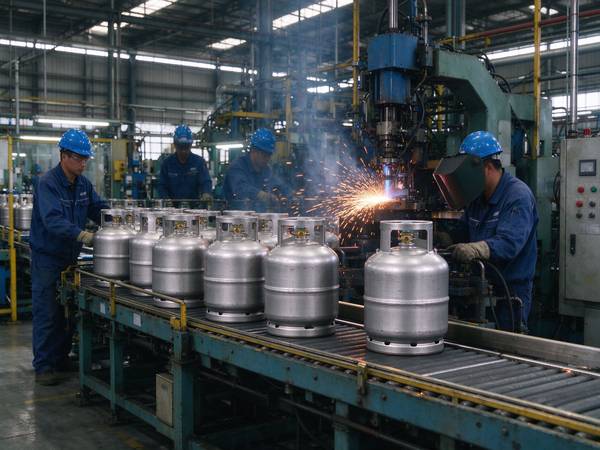
The upper half — the shoulder and neck ring — is formed separately and then welded to the lower shell using automatic circumferential MIG or TIG welding. Welding parameters (current, voltage, travel speed, shielding gas flow rate) are monitored continuously and logged for each batch. After welding, every single cylinder undergoes radiographic testing (X-ray or ultrasonic) on the circumferential weld to detect any internal porosity, lack of fusion, slag inclusion, or crack. Rejected cylinders are scrapped — there is no repair, no rework, no second chance. This non-negotiable stance is what separates a quality cylinder manufacturer from a commodity producer.
The next critical step is the hydrostatic test. Each empty cylinder is placed in a reinforced test bay and filled with water, then pressurized to the specified test pressure — typically 3.3 MPa (480 psi) for DOT cylinders, 3.0 to 3.4 MPa for EN1442 and GSO cylinders. The cylinder is held at pressure for a minimum of 30 seconds while an operator checks for permanent deformation, leaks at the weld or neck, and pressure decay. A precision measuring device records the volumetric expansion, confirming the cylinder is within the allowed expansion and contraction parameters. A cylinder that shows excessive permanent expansion is rejected. This is the single most important safety test in the entire process — it proves the cylinder can withstand pressure far above normal operating conditions.
After hydrostatic testing, cylinders are shot-blasted to remove mill scale and surface rust, then receive a protective zinc-rich primer coat followed by a final polyester powder paint. The painting line is fully automated, ensuring uniform film thickness and coverage — important because paint is the cylinder’s primary defense against atmospheric corrosion over decades of outdoor storage. The cylinders are then oven-cured at controlled temperature, and the film thickness is measured with an electromagnetic gauge at the start of every shift.
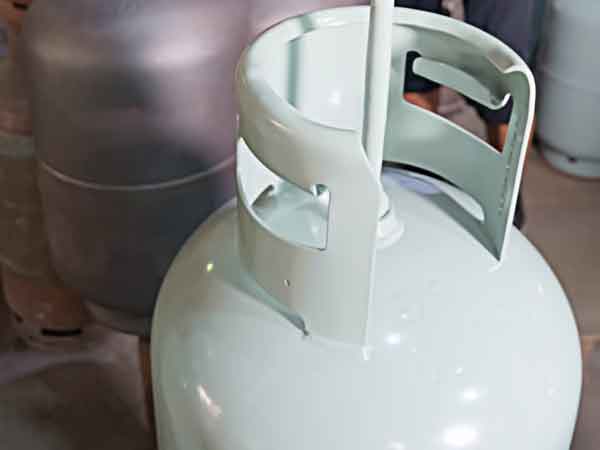
The valve is installed at the neck with a precisely torqued fitting (typically 55 to 65 Nm depending on valve size), and the completed cylinder undergoes a final pneumatic leak test. Air or nitrogen is introduced at working pressure, and the valve, neck weld, and threads are submerged in water or checked with an electronic leak detector. Any bubble means the cylinder is rejected. The valve operation is also tested — the handwheel or knob must turn smoothly, open and close fully, and hold pressure in both positions.
The quality control process does not stop at the factory gate. Qingdao Evergreen’s export team conducts a final pre-shipment inspection (PSI) at the factory before container loading. This includes: random sampling of cylinders from the batch (typically AQL 2.5 level), checking dimensions (height, outside diameter, wall thickness at the base, base diameter, guard diameter), verifying permanent markings (standard number, water capacity, tare weight, manufacture date, OEM mark), confirming paint finish and color against approved swatches, and inspecting valve installation and operation. Loading photos and inspection reports are shared with the customer before the container sails. For customers who require it, third-party inspection by SGS, BV, Intertek, or TUV can be arranged.
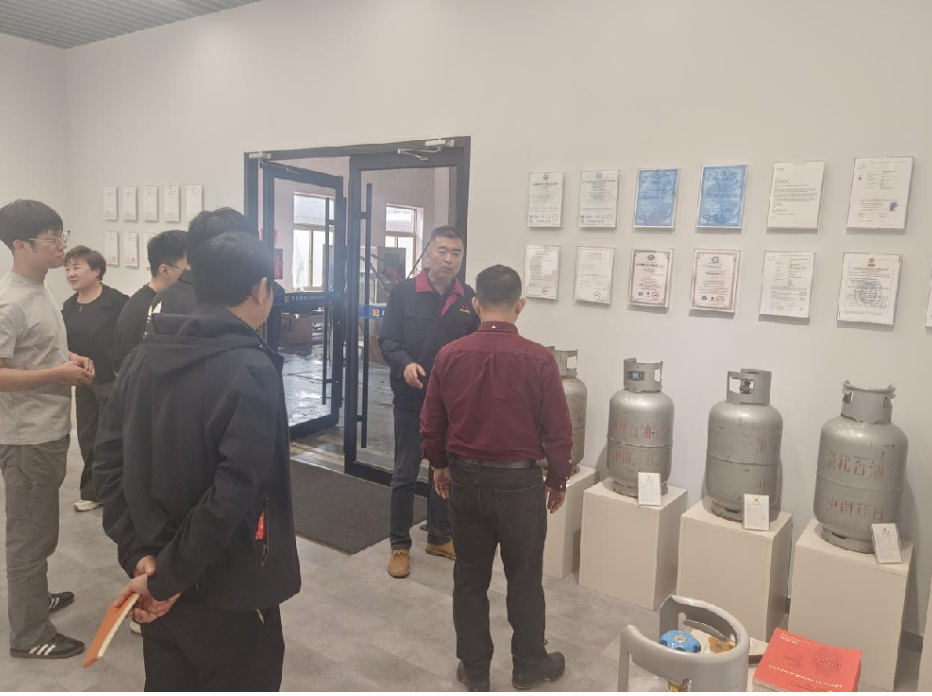
The manufacturing partners behind Qingdao Evergreen are themselves among the most experienced cylinder producers in China — a country that now exports the majority of the world’s refillable LPG cylinders. They hold China Special Equipment Manufacturing Licenses (the equivalent of a national pressure vessel authority approval), and their products have been type-approved by the U.S. DOT, Transport Canada, EU notified bodies for EN1442, Saudi SASO, Nigerian SON, and the Australian Gas Technical Regulators Committee.
ISO 9001 certification is table stakes, but the factory’s internal standards go further. In-line gauges automatically reject blanks that are out of thickness tolerance. Welding parameters are logged to a central database for full traceability. Paint thickness is measured with an electromagnetic gauge at the start of every shift. Final inspection includes a drop test on a random sample — the cylinder is dropped from a specified height onto a concrete surface to verify that no crack, leak, or permanent deformation occurs. A burst test is also conducted periodically on sample cylinders to verify the ultimate burst pressure, which must be at least 2.4 times the working pressure.
For the customer, this manufacturing rigor translates directly into lower total cost of ownership. A well-built cylinder lasts 15 years or 50 refills. A poorly built one may fail its first hydrostatic requalification test at 5 years, or worse, fail in service. The modest price premium of a quality cylinder is paid back many times over in reduced scrap, fewer insurance claims, and stronger brand reputation with end consumers. Qingdao Evergreen’s role is to connect this manufacturing excellence to global markets — handling the certification, documentation, logistics, and after-sales support that turn a factory product into a delivered, ready-to-use cylinder on a customer’s loading dock.