
Every few years a new energy story promises to reshape the gas industry. Hydrogen is the most persistent of them. While much of the conversation focuses on pipelines, fuel cells and heavy transport, a practical question is quietly emerging for anyone who makes or sells cylinders: can these vessels serve a changing gas landscape?
The honest answer is that today’s LPG cylinders and hydrogen cylinders are different products with different requirements. But the boundary is not fixed, and understanding where it sits is valuable for anyone planning the next decade.
Why Hydrogen Is Different
Hydrogen is the smallest molecule and behaves very differently from LPG. It is stored at much higher pressures, it can embrittle certain metals, and it leaks through joints that would hold propane perfectly. A cylinder designed for LPG at moderate pressure is not suitable for high-pressure hydrogen service.
Hydrogen cylinders typically use different materials, thicker walls or composite construction, specialised valves and far more stringent testing. Standards such as ISO 9809 for seamless steel gas cylinders and various composite standards govern their design.
This means the mainstream LPG cylinder manufacturer cannot simply relabel a product for hydrogen. Entering that market requires new design, new certification and new production discipline.
Blending: The More Immediate Opportunity
Pure hydrogen is one thing; blending it into existing gas networks is another. Many utilities are exploring hydrogen blended into natural gas at low percentages as a way to reduce carbon intensity without rebuilding the entire network.
For cylinder users, blending raises practical questions. Low-level blends may be compatible with some existing equipment, but material compatibility, combustion behaviour and safety detection all need review. Flame characteristics change, and leak detection systems tuned for one gas may not respond the same way to another.
At present, LPG cylinders are not the main vehicle for hydrogen blending. Most blending discussions concern piped natural gas. But the broader point stands: the gas delivered to a customer in the future may not be identical to the gas of today, and equipment specifications will need to keep pace.
Composite Cylinders and the Hydrogen Connection
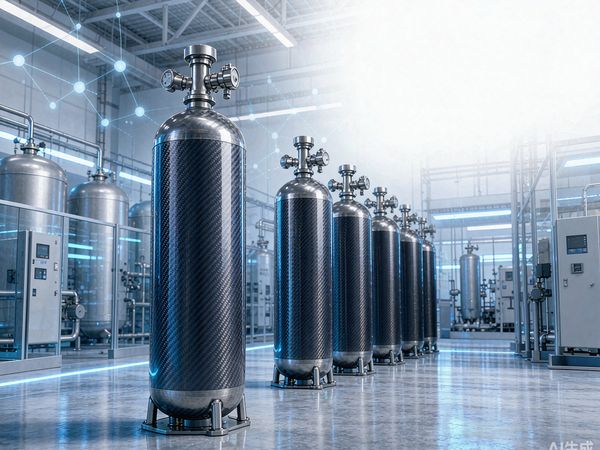
Where hydrogen does create a direct opportunity is in composite cylinder technology. Type 3 and Type 4 composite vessels are already used for compressed hydrogen in vehicles and industrial applications because they offer high strength at low weight.
The manufacturing knowledge overlaps with composite LPG cylinders: filament winding, liner design, resin systems and pressure testing. A producer with strong composite capability is better positioned to serve both markets. This is one reason the composite shift in LPG is strategically important beyond its immediate weight benefits.
Steel is not excluded. Seamless steel hydrogen cylinders are well established for stationary storage and industrial use. But the requirements — especially pressure rating and material purity — are more demanding than typical LPG service.
What This Means for the LPG Cylinder Business
In the near term, LPG remains a distinct and robust market. Global demand for bottled gas is still growing, especially in regions without piped infrastructure. The energy transition is not going to eliminate that demand quickly.
The risk is not that LPG cylinders become obsolete. It is that manufacturers who ignore the skills required for future gases lose the chance to diversify. The capabilities that matter — high-pressure design, composite manufacturing, advanced testing, precise valve technology — are transferable.
A sensible strategy is to strengthen the core LPG business while quietly building capability in adjacent gas technologies. That means investing in composite expertise, improving testing and materials knowledge, and watching how standards evolve.
Safety Must Lead the Conversation
Hydrogen’s reputation is shaped by its flammability and its tendency to leak. Any move into hydrogen service demands a safety culture that goes beyond normal LPG practice. Ventilation, detection, materials selection and connection design all become more critical.
Companies that treat hydrogen as a marketing opportunity rather than an engineering challenge will struggle. The technical barriers are real and the safety margin is narrower.
For now, the most responsible message for the LPG sector is a confident one: bottled LPG has a long and useful future, and the industry’s core competencies are relevant to what comes next. But preparation should start early.
Quick Takeaways
- Hydrogen cylinders are technically distinct from LPG cylinders, with higher pressure and stricter material demands.
- Hydrogen blending is advancing mainly in piped gas, not bottled LPG, for now.
- Composite cylinder expertise is the clearest bridge between the two markets.
- LPG demand remains strong in regions without piped infrastructure.
- Building adjacent capability now is smarter than waiting for a sudden shift.
Frequently Asked Questions
Can an LPG cylinder be used for hydrogen?
No. Hydrogen requires different pressure ratings, materials and valves. Never convert a cylinder between gases without proper certification.
Is hydrogen blending already common?
It is being explored and piloted in several regions, mostly in piped natural gas networks rather than bottled gas.
Does the energy transition threaten LPG demand?
Not in the near term. Bottled gas remains essential in many parts of the world.
Which skill transfers best to hydrogen cylinders?
Composite cylinder manufacturing and high-pressure testing knowledge.
The bottom line: hydrogen is not a threat to the LPG cylinder business today, but it is a signal about where gas technology is heading. The manufacturers who invest in transferable capability will be ready when the market moves.